The Prophecy
By Steven Sukot
(In 1975, when PNG was born, our fathers released a prophetic statement over the life of the nation…now 36 years on, I just want to remind us of this prophecy)
What the Constitutional Planning Committee wrote when the nation was born is actually a prophesy into the life of the nation at its birth. It is a normal practice in Melanesia for the old and wise to speak into the life of a child at birth when dedicating and blessing the child. This is in fact a prophetic statement on the eve of the independence of Papua New Guinea. Every sons and daughters of this land should know and understand this. What the nation is encountering today with the overdrive emphasis on extractive industries especially in the mining, petroleum, oil and gas development might become a curse. The eyes of wisdom saw the future unfold 36 years ago and issued the warning. With the Vision 2050, medium term development strategies and economic policies we pursue as a nation, be warned, that our dreams will become nightmares if we despise this prophecy.
Lest we forget;
We see the darkness of neon lights.
We see the despair and loneliness in the urban cities.
We see the alienation of (the people) that is the result of the
present machine orientated economy.
We see true social security and (the people’s) happiness being
diminished in the name of economic progress.
We caution therefore that large-scale industries should be pursued only after very careful and thorough consideration of the likely consequences upon the social and spiritual fabric of our people…
There is overwhelming evidence to suggest that a significant number of people who live by the fruits of multi-million dollar multi-national corporations live in misery,loneliness and spiritual poverty.
We believe that since we are a rural people, our strength should be essentially in the land and the use of our innate artistic talents.
(Papua New Guinea Constitutional Planning Committee, 1975).
Papua New Guinea is on the pinnacle of major resources boom in the country and the government is doing its best to create an investment friendly environment at the same time customary landowner issues are reaching boiling point all around the major resource development and proposed project sites.
Landowner issues ranging from, consultation processes, agreements, landownership, participation, environmental plans and permits, social mapping and spin off businesses are some of the issues are raised from the major resource development projects in PNG.
Landowners from the major project areas in PNG have been fighting in isolation to address their concerns since the first resource development project in the country was developed. However, for the first time in the history of PNG, four (4) major project sites and project impacted areas came together to join forces to address their issues.
In a joint press conference held at the Aku Lodge conference room on the 20th of July 2010, representatives from the Watut River Union (Morobe), the riverine communities union organizing around the impacts on the Watut river system by the Hidden valley mine, Raicoast Anti-DSTP group (Madang) who are opposing the plans for the dumping of the Ramu Nickel mine waste into the Basamuk Bay , representatives from the clans from the LNG project (Hela) who did not signed the benefit sharing agreement, Unitech students from the new Hela province, New Ireland Resource Watch, the people's movement of the New Ireland Province who oppose the deep seabed mining, the Bismarck Solomons Sea Indigenous People's Council (BSSIPC) also opposing deep seabed mining and the Madang People's forum (MPF)collectively want the government to respond to their major concerns respectively, review all these projects and repeal the new environmental act.
The group made a strong call to Somare to step down and NA to be removed from the government, because they claim the current NA/Somare government is not representing the interest of the people and seen to be driven by foreign investors. If there is going to be a change in government, the group made it clear also that, these demands need top be looked into immediately. The press conference was done a day before the adjournment of the parliament to November. However the group was very clear that if the government does not change or if the new government will not look into their demands, then the people will take it upon themselves to clean up the mess.
This group is also calling on all other landowners from other project areas in PNG to come together and work together because, the government is serving foreign interests.
Sir Micheal Somare - the right thing to do is to step aside as Prime Minister _______________________________________________________________
The right thing for Sir Michael Somare to do to promote and uphold good and ethical government, protect the good name of the Office of Prime Minister and set a better example for leadership in PNG, is to step aside as Prime Minister now; and allow investigations to be conducted by relevant law enforcement agencies into serious allegations that he broke a number of laws in the Moti Affair.
The Moti Affair
The Ombudsman Commission submitted to the Parliament its report on the Moti Affair. The Parliament rejected the Report on 10th March 2010. In the recent sitting of the Parliament, no mention was made of the Report or of the Moti Affair generally. Should PNG just forget about this episode, just like other similar issues in the past, as it if it never happened?
This one should not be forgotten.
The Moti Affair should not be forgotten because it involved allegations of unlawful conduct on the part of the person holding the Office of Prime Minister. The person occupying that Office, Sir Micheal Somare, was accused of beaching PNG’s laws including committing criminal offences. If PNG is ever to tackle serious issues about whether the rule of law exists in the country and issues of governance (mismanagement, corruption, etc.) facing PNG, we must ensure that the matters raised by the Moti Affair are properly investigated. The image of the Office of Prime Minister has been tarnished.
Office of Prime Minister is separate from Sir Michael Somare
The Office of Prime Minister is the top most leadership position in PNG. It belongs to the people of PNG. It does not belong to an individual.
An individual occupying the Office of Prime Minister must be the first to respect the Office. If any wrong doing is alleged against the person occupying the Office, and the allegations made are serious, the person holding the Office must, at the least, step aside as Prime Minister and allow investigations to be conducted. To not to do so is to bring the Office of Prime Minister into disrepute, damage its image and set a bad example of leadership down the line.
The Ombudsman Commission’s report on the Moti Affair highlighted breaches of a number of laws. They are serious in two respects. One, the laws broken are important laws. Two, the Ombudsman Commission report’s findings raise allegations that require further investigation by relevant authorities without being compromised, real or apprehended.
For the appropriate authorities to conduct the investigations without the appearance of influence by Sir Micheal Somare remaining in the Office of Prime Minister, Sir Michael Somare ought to step aside to allow these investigations to be conducted. There is already a perception in the minds of many Papua New Guineans that any investigations will come to nothing because Sir Micheal Somare is the Prime Minister. This is a bad indictment on the rule of law in PNG.
Serious allegations against Sir Michael Somare in the Moti Affair
The single most serious allegation made against Sir Michael Somare is that he gave directions for Julian Moti to be removed from PNG whilst judicial processes were still in play.
In its 2009 Report, the Ombudsman Commission said that, from evidence available to it, in its opinion, Sir Micheal Somare gave the direction for Julian Moti to be removed from PNG to Solomon Islands. Sir Michael Somare has denied giving such a direction.
Whether or not Sir Michael Somare did or did not give the direction must be determined by the appropriate authorities. The Ombudsman Commission has formed the view that Sir Michael Somare gave the direction. Sir Michael Somare says he did not. Sir Michael Somare is not guilty of anything. But, he stands accused by a competent constitutional office – and the accusations are serious. Sir Michael Somare ought not to occupy the Office of Prime Minister until he is cleared.
But the Ombudsman is not the only body that has reached this conclusion. A defence force inquiry in 2007, headed by a senior judge, reportedly made similar findings as the Ombudsman Report. Sir Michael Somare took court action to stop the release and publication of that inquiry report in late 2007.
To protect the good name of the Office of Prime Minister, to establish better standards of ethics in leadership, and to remove any perception in the minds of Papua New Guineans that he will influence investigations by relevant authorities; respecting the people’s Office of Prime Minister, Sir Michael Somare ought to step aside. There is good example of this. Sir Julius Chan stepped aside as Prime Minister to allow an inquiry to be conducted in the Sandline Affair. Here, the situation is more serious, in that, the Ombudsman Commission has already formed the view that Sir Michael Somare gave a direction that led to breaches of a number of laws.
What are the Ombudsman Commission’s findings? On the mid-night to early morning of 10 October 2006, Julian Moti was flown out from Port Moresby to Munda in the Solomon Islands in a PNG Defence Force (PNGDF) aircraft.
·On 30th September 2006, the District Court had revoked an earlier warrant for Julian Moti to be released and ordered that Mr. Moti be arrested and detained. If Sir Michael Somare gave directions for Julian Moti to be taken out of PNG, as the Ombudsman Commission concluded, this was a direct violation of the orders of the District Court. This is serious because it is contempt of court and brings into conflict the separation of powers – between the judiciary and the executive government.
·The flight from Port Moresby to Munda was not approved by the civil aviation authorities as required by laws applying to aircraft flights. These laws were broken. It was also dangerous. The airfield at Jacksons airport was not lighted, and the PNGDF aircraft flew out at 1:00am in the dark. Breaches of these laws implicate Sir Michael Somare if he gave the direction for Julian Moti’s removal as the Ombudsman Commission concluded.
·Only the National Executive Council has the power to direct the PNGDF to undertake missions such as that involving the flying out of Julian Moti from PNG to Solomon Islands. If Sir Michael Somare gave the direction, as the Ombudsman Commission concluded, this was a breach of laws that apply to the PNGDF.
·Police were also directed by government officials not to arrest and detain Julian Moti as ordered by the Court. This is an interference in the independence of the Royal Papua New Guinea Constabulary and itself a contempt of court.
The breaches of these laws are serious, and they must be properly investigated. And, Sir Michael Somare stands accused in these serious breaches.
Attack on the Ombudsman Commission
Like the office of the Prime Minister, the Ombudsman Commission as an institution belongs to the people of PNG. It is an important office established by the Constitution of PNG.
In statements made in Parliament and published in newspapers, Sir Michael Somare criticised the Ombudsman Commission’s report “stupid and disappointing” and its contents as reflecting “very poorly of the integrity and objectivity of the Ombudsman Commission in the conduct of its duties”.
Already, this criticism of the Ombudsman Commission demonstrates why Sir Michael Somare ought to step aside as Prime Minister and allow those investigations to establish whether or not Sir Michael Somare is guilty of what he has been accused of. The people’s Office of Prime Minister cannot be used, by the person occupying it, to attack an important constitutional office like the Ombudsman Commission that also belongs to the people of PNG. The Ombudsman Commission findings were against Sir Michael Somare as an individual, not the office of Prime Minister.
Other events which have taken place before and since the Ombudsman Commission’s report into the Moti Affair raise serious questions as to whether Sir Michael Somare (as Prime Minister) is unfairly prejudiced against the Ombudsman Commission.
·The Maladina sponsored amendments to the Constitution and the Organic Law on Duties and Responsibilities of Leadership have been controversial. There is suspicion that these important legislative measures, some parts of which will cut down the powers of the Ombudsman Commission, are being handled with prejudice by the Government that Sir Michael Somare leads.
·The Chief Ombudsman, Chronox Manek, was attacked by criminals recently and it has been said that it was an attempt on his life. Neither the Prime Minister nor any other Minister condemned the attack. The perception is reinforced that Sir Michael Somare and his Ministers are prejudiced against the Ombudsman Commission and are unable to do what is required of them as leaders – to speak out against such attacks to protect individuals who work in public institutions which involve risks.
·Sir Michael Somare stopped the publication of the Defence inquiry report headed by Justice Gibbs Salika. Not only did this discredit a senior judge of the third arm of government, the judiciary, but the perception remains that Sir Michael Somare stopped the inquiry to protect himself.
Do the Ombudsman Commission’s conclusions made on Sir Michael Somare in the Moti report have basis?
Anyone who has read the Ombudsman Commission’s report of the Moti Affair will see that the Ombudsman Commission’s conclusion that Sir Micheal Somare gave the direction for Julian Moti to be flown out of PNG came from one person’s evidence – the evidence of the late Joseph Assaigo, then Director-General of Office of Security Coordination and Advisory. Assaigo told the Ombudsman Commission that Sir Michael Somare’s then Chief of Staff Leonard Louma told him (Assaigo) that the Prime Minister wanted Julian Moti to be removed from PNG, and Assaigo and then Chief Secretary Joshua Kalinoe were to do this.
Assaigo’s was the only evidence stating to the effect that Sir Michael Somare gave the direction for Moti to be taken out of PNG. There was no other evidence. Assaigo was a lawyer and a public servant for many years.
However, two critical people did not give evidence to the Ombudsman Commission. They were Leonard Louma and Joshua Kalinoe. The Ombudsman Commission wanted their evidence but, on the specific matter of the removal of Moti from PNG to Solomon Islands, Sir Michael Somare stopped Leonard Louma and Joshua Kalinoe from giving evidence to the Ombudsman Commission. This, Sir Michael Somare did, by using Section 19 of the Organic Law on Ombudsman Commission, which permits a Prime Minister, after consultations with the Ombudsman Commission, to certify that giving information on a subject matter would prejudice the security, defence or international relations of PNG; or giving information would involve disclosure of proceedings, deliberations or decisions of the National Executive Council.
The use of Section 19 by Sir Michael Somare in this way raises more questions. The first is - why did Sir Michael Somare prevent Leonard Louma and Joshua Kalinoe from being questioned by the Ombudsman? Second, by using the power given to the Prime Minster by Section 19, some may say that Sir Michael Somare had something to hide and did so to protect himself. This is another example of why the individual occupying the Office of Prime Minister must be separated from the Office of Prime Minister. Otherwise, the actions of the individual will result in illegitimate exercise of the powers, functions and damage the image of the people’s Office of Prime Minister.
Parliament is neglecting its duty to scrutinise the executive government
On 10 March 2010, the Parliament rejected the Moti Affair report submitted by the Ombudsman Commission. The manner of the presentation of the Report was questioned by certain Members of Parliament (MPs). Would the Report have been tabled if it was given to the Government to table? Chances are that it would not have been allowed because of the complete control and subjugation of the Parliament by the executive.
Members of Parliament completely abrogated their responsibilities as members of the legislature to examine and debate the Report and its findings properly. MPs did a complete disservice to the people of PNG.
Very serious breaches of the country’s laws were alleged. The Prime Minister was accused of breaching these laws by the Ombudsman Commission. Instead of taking these issues seriously and examining the conduct of the executive, the Parliament rejected the Report. What is the role of Parliament if it cannot inquire into questionable actions of the executive? What is the role of MPs? In the recently concluded sitting of the Parliament, nothing was mentioned of this serious issue. It has prompted me to write this.
The Parliament is fast losing its legitimacy. That legitimacy does not come from those elected exercising power given in elections but from the people. If the people perceive that Parliament is not doing what it should be doing (including supervising the executive government), the people have the right to ask that Parliament must disband itself. MPs must not take the people of PNG for granted.
What is my interest in raising these matters?
I raise these issue as a citizen concerned about the state of poor governance in PNG – evidenced by gross mismanagement, corruption, bad ethics and poor standards of leadership, and serious challenges to the rule of law. As a lawyer interested in public policy issues, I feel obliged to do this since most professionals and professional organisations have been silent on important issues of governance in this young country in general and, more specifically, the rule of law in particular. It would be dishonest of me if I did not do this.
The Moti Affair raised serious breaches of the laws of PNG. And the country’s Prime Minister has been implicated in criminal conduct.
No one else can set the tone and standard of leadership than the Prime Minister. The country’s Prime Minister must be seen to uphold the laws of the country.
The perception that there is one set of laws for the poor and weak, and another for the rich and powerful must be corrected. The important principle that everyone is equal before the law must be upheld and be seen to be promoted especially by the top leaders of the country.
I am not a politician. I have never supported any political party. My only interest is simply this - I am concerned about the poor state of the country in terms of governance and the rich and powerful not respecting the rule of law. The standard of ethics, of leadership example, and the values that we the current generation in control of PNG’s affairs are cultivating and setting for the young people, is very poor.
Sir Michael Somare can correct this by doing the right thing now – by stepping aside as Prime Minister and allow the accusations made against him in the Moti Report to be fully investigated by relevant authorities without fear of repercussions on the part of those whose job it is to do so, real or apprehended. The person who gave evidence of Sir Michael Somare giving the unlawful directions, Joseph Assaigo, has passed on. The other persons who can give evidence to relevant authorities are Leonard Louma and Joshua Kalinoe. Sir Michael Somare ought to step aside as Prime Minister, allow these two men to fully cooperate with the law enforcement agencies so that those who broke the law can be properly dealt with. Otherwise, the breaches of these laws will be forgotten, like many others in the past. Where then is the rule of law? Should we pretend that these things never happened? We cannot. Julian Moti was in PNG. Some individuals broke PNG’s laws and removed him clandestinely from the country. They must be dealt with!
The people have the right to demand, as we did during the Sandline crisis against the then Prime Minister Sir Julius Chan, that Sir Michael Somare step aside as Prime Minister.
The PNG government is running this country with total madness.There is absolute negligence of its purpose, mandate, function and responsibility has seen in the recent amendment to the Environmental Act 2000.
The Amendment basically removed the powers of the people as landowners to sue the state and the companies on environmental damages. This amendment was done in the light of the legal challenge lounged by the people of Raicoast against the Deep Sea Tailings Placement (DSTP). Based on scientific reports stating that the impacts of the tailings would cause a severe impact on the marine ecosystem along the Madang coastlines including Karkar and Bagabag islands, the Raicoast landowners took an injunction in court to stop the consstruction of the DSTP system.
The Raicoast people also petitioned the government against the DSTP. The government and the Chinese miner have been blaming the NGOs for instigating the resistance. However, despite the court proceedings and the petition, the government decided to change the law to legalize its action and remove the powers of landowners to take court action on issues relating to environmental concerns.
The new amendment to the Environmental Act 2000, is a worst legislation and against the spirit of democracy, human rights and the constitution of PNG. With this amendment, the government literally removed democracy.It is becoming obvious that the government has become a "puppet" of CMCC and Exxon Mobil.
Right across the country there is public outcry against this amendment. If that Act is not repealed, the government is simply asking for trouble as there is so much tension and pressure building up and will explode any minute. NOW is the time to force the government to repeal the amendment. Now is the time to challenge this dictatorship. If we fail to force the government to repeal the amendment-Goodbye Democracy. PNG get ready for the worst to come!
The core strength to environmental protection in PNG is the customary land tenure system and the fact that the environmental act before the amendments considered landowners traditional rights and protected it under the law. That has been my view every since I watched a film (forgot the title) in my environmental science class at the university of PNG as a final year student.
That video was about a medical scientist doing research on traditional medicine somewhere in the Amazon forest. The medical scientist spent 10 years of research with an indigenous tribe that lives in that forest area. The research involved traditional and indigenous knowledge of various plants, barks, roots and leaves.
One day the government decided to sell the land to a company who decide to clear fell the forest and build a cattle ranch. Without warning or negotiation with the indigenous tribe who lives in that forest area, the company dispatched heavy machinery clear fell the forest and burn it at the same time. It was the fire that destroyed the indigenous village and the research centre. The forest people lost their homes and everything while the medical research work for 10 years was completely destroyed.
Two things came to my mind as I was watching the film in my class.
1.Firstly, that indigenous forest community did not have their traditional rights protected under the law of their country and therefore their government did whatever it pleased and it was non-negotiable. There was no consultation and there was no free prior informed consent. Therefore, that forest community was forced to evacuate their traditional village without any form of compensation or relocation plans from their government.
2.Secondly, the 10 years of medical research based on traditional and indigenous knowledge of forest people which would have resulted in the cure for various diseases we have today was destroyed in the furnace.
That film inspired me to be a strong advocate of customary land protection in PNG and I have always referred to many times especially in discussions on environmental protection and customary lands.
The fact that the government and the companies in PNG had to go through a lot of hassles to deliberate on landowners’ issues which is in fact an impediment to their progress, but from the landowners’ perspective, it is a ‘buffer’. That buffer provides for the avenue for all negotiations with consent landowners with regard to any project development and that includes issues relating to environment. By removing the traditional land rights of landowners from taking legal action on environmental damage will escalate environmental impacts by project developers.
I feel it is not wise to remove this important buffer by changing the Environmental Act. The government should be representing the interest of its people and not foreign investors. Given the fact that the number one crisis affecting and threatening both the rich and poor nation in the world is directly related to environmental issues now resulting in global warming and climate change. Therefore it is the last thing; we want to see our government going down the track of environmental irresponsibility especially on the eve of June 5 –the World Environment Day.
PNG government urged to prepare for severe drought
Posted at 22:45 on 10 May, 2010 UTC
A leading climate change scientist says it’s essential that Papua New Guinea’s government takes urgent steps to prepare for a severe drought which is expected to affect the country around 2012.
Scientists at PNG’s National Agriculture Research Institute has warned that the country can expect a mega-drought in 2012 which could last for up to 18 months, posing major health risks and food shortages around the country.
The Institute’s principal scientist, Dr John Bailey, says that developing sustainable water supply and adaptable crop production systems is imperative.
“We do have to do something and relatively urgently because it will take time to do all of this. It doesn’t just happen over night or even over months. it’s going to take a year or a few years to get all this sorted out. We will hopefully see an iniative taken in the next two or three months to start off a taskforce of different organisations brought together to sort of address this particular issue.”
“Development” is the catchphrase over used by promoters and advocates of Customary Land Reform in Papua New Guinea. The government and major donor agencies see Customary Land Tenure System to be a major default for development and economic progress. They see that access to Customary Lands is an important factor in economic development in Pacific island countries and a major consideration for investors. Financial institutions are also unlikely to lend money on custom lands; therefore it locks the economic potential and opportunity for these lands to be developed.
Our Melanesian Perspective:
We see development in terms of physical, spiritual and mental empowerment of people and our concern is the development of the whole person as we want people to grow. Too much control prevents people from advancing and therefore we want to provide space for people to discover themselves, improvise, and develop ideas that suit their needs and situation and the environment they live in. An empowered people or community has the holistic potential to cause them to progress by making informed decisions and be the master of their own destiny. We hope to see our people rise to become truly self reliant. Personal transformation is what our people need and we believe it is more sustainable than material development.
These cannot be valued in monetary and the western economic standards. These are the essence of life to us Melanesians and we highly esteem these values. Why commercializing our only link to our values. When you see the dollar, it blinds you to see the Melanesian view of land.
We are not stupid to understand that there are major problems faced by the developed world which they can not solve with all the money they have. They boast to have low poverty levels, yet, there are millions on the streets who are home less and have nothing to eat. This is the situation with the United States today with the struggling US$. Because of our land tenure situation, we do not see these problems. For example, families without any form of income generation or formal employment who earn less than a US$1 dollar a day still have plenty of organic food to eat and share with others, a simple hut to sleep in, with access of water from streams, creeks and rivers to cook and wash, and there is laughter and dancing and high moral standards.
We are not stupid to know that, the developed countries have no intent to help us get to the same standards as them. They are here because of our rich threshold of natural resources. Nevertheless, even if they have some good intentions, we fully understand that we are a different group of people with different beliefs, cultures and values. Therefore what the white men proposes is from his context, believe, culture and value. We can never be like the whites and do not think it is wise to copy or live a life of pretence and self denial. The Africans never got it right and we can never dream to get it right without the people maintaining control of the land. It will be a tragedy and chaotic for Melanesian to be landless and forced to live in an individualistic society without any spiritual and cultural connections. Once our land is gone, we’ll be defeated foreigners in our own land and also present to our dear children a future of alcoholics, drug addicts and prostitutes. It is our greatest fear to end up like Africa.
Thus, there is no better conclusion than this:
We see the darkness of neon lights. We see the
despair and loneliness in the urban cities. We see
the alienation of (the people) that is the result of the
present machine orientated economy. We see true
social security and (the people’s) happiness being
diminished in the name of economic progress. We
caution therefore that large-scale industries should
be pursued only after very careful and thorough
consideration of the likely consequences upon the
social and spiritual fabric of our people…There is
overwhelming evidence to suggest that a significant
number of people who live by the fruits of multi-million
dollar multi-national corporations live in misery,
loneliness and spiritual poverty. We believe that
since we are a rural people, our strength should
be essentially in the land and the use of our innate
artistic talents. (Papua New Guinea Constitutional
Planning Committee, 1975
The value of Ramu Ni-Co project quoted in The National newspaper is misleading. It also holds the largest Sino-Australian nickel and cobalt project worth $US1.7 billion (K4.6 billion)” from the article entitled “PNG on a verge of a Boom”.
For brevity, Ramu laterite deposit contains 1.44 million tons of nickel and 0.143 million tons of cobalt within a reserve of 143mt at 1.01 per cent Ni and 0.1 per cent Co. At today’s buoyant prices of $US9/lb for nickel and $US20/lb for cobalt, the in-situ value of contained nickel and cobalt in the Ramu project stands at about $US28 billion and $US6 billion.
So the actual value of Ramu nickel cobalt project is $US34 billion or K92 billion at today’s prices. This excludes exploration dollars already spent on the project. This mine will produce in excess of 31,000 tonnes of Ni and 3300 tons Co annually for a period of 20 years (with the potential for up to 30 years). The worth of metals produced annually may exceed $US750 million subject to fluctuating metal prices and production capacity. This is somewhat equivalent to well over K2 billion per annum at today’s exchange rate and metal price.
Sadly, 85 per cent of the ownership of the Ramu mineral resource was sold to MCC, the Chinese state owned enterprise for a mere 5 per cent ($US1.7 billion) of the total value of this mega resource. So the $US1.7 billion is the construction and initial operating costs.So how much is left for PNG or Papua New Guineans? Barely 10 per cent (because HPL is a public listed company) in the bones as usual through the following entities: -
* 8.56 per cent Highlands Pacific Limited
* 3.94 per cent MRDC
* 2.5per cent landowners
To set the record straight, the present value of Ramu mine is worth about $US34 billion (K92 billion) and not $US1.7 billion (K4.6 billion) at today’s price but unfortunately very little if not none will be reflected in long-term tangible development of Papua New Guinea. Indeed it is another example of broad daylight rape and exploitation of Papua New Guinea. PNG government and its entities must act radically and swiftly in changing the current trends in order to maximise realisation of the natural resources for Papua New Guinea. Sadly, PNG government is continuously selling multi-billion-dollar resources cheaply, for next to peanuts because it seems to lack comprehension and in-depth analytical skills compounded by greed and ignorance.
Kaul Gena, Ph.D
Senior lecturer
Western Australian School of Mines
Sometime in the fall last year, I was at my local supermarket in San Francisco’s Mission District, picking through some melons when I heard the unmistakable sound of a body hit the floor behind me — hard. I turned to find a woman being handcuffed and led into an employees-only area, as she pleaded with the security guard: “I lost my job and need to feed my children.” It was nothing short of heartbreaking.
Later, as I waited to pay for my groceries at the register, I watched another woman set off an alarm as she ran out of the supermarket with bananas and baby food in her arms. She made it — and presumably was able to feed her child that night.
I thought of that desperate day again when I read an extensive report released today on the state of food hardship in America (pdf) by the Food Research and Action Center (FRAC). In it comes the striking news that one in five Americans went hungry at some point in 2009.
Food hardship was measured as those who responded affirmatively to the question, “Have there been times in the past twelve months when you did not have enough money to buy food that you or your family needed?” By the end of last year, the national food hardship rate was 18.5 percent. For households with children, the rate was much higher, at 24.1 percent.
For the general population, food hardship, which is the most basic indicator of general socio-economic hardship, was higher in 2008 than in 2009, but let’s not pat ourselves on the back just yet — one in eight Americans are on food stamps today. Indeed, it appears that thanks to social programs like SNAP, food hardship did not continue to skyrocket throughout last year. With the recession, eligibility for food stamps was eased and benefits were increased. (Thank you, welfare state!)
Most of the report’s stats are dismal — and I could continue enumerating them to paint a more detailed picture of our hunger crisis, but I would rather hone in on the data that might hold some real political capital. You can speak about national hunger rates but hawking national data doesn’t hold reluctant or deluded politicians accountable — America is a large, amorphous entity for which everyone ought but often no one feels responsible or moved to act.
That’s why I am especially excited by the fact that the FRAC report gives us a highly localized look at hunger in America — and breaks it down by congressional district:
Of the 436 Congressional Districts (including the District of Columbia), 311 had a food hardship rate of 15 percent or higher. In 139 of them the rate was 20 percent or higher. Practically every Congressional District in the country had more than a tenth of respondents reporting food hardship.
Districts with the worst rates can be found in a whole range of states — California, Florida, Georgia, Illinois, Michigan, Texas, Mississippi, New York — but, on the aggregate, hunger is most widespread in the South. These are districts represented in Washington, for the most part, by right-wingers and Democrats-only-in-name generally opposed to the expansion of welfare programs, even in the face of a massive recession.
This report could not have come at a better time. Just this morning came news that the Senate is planning a $80 billion job-creation bill that will cut Americans’ extended unemployment benefits (the House bill would not do this). This is the kind of boneheaded move that is predicated on the infallibility of the welfare-state-is-bad and/or anything-but-debt theses, and not in reality.
The battle worth fighting in 2010 is one that steers the government back to caring for the interests of regular Americans — and away from the corporations and financial institutions that have benefited most from governmental attention in this recession. There will be a lot of debate — and one-sided fear-mongering — about the expansion of low-income social assistance and unemployment programs, ranging from food stamps to COBRA; there will be a lot of talk about rising debt and budget-freezing, too.
But reports like FRAC show that as bad as hunger is today, it would be far worse without the social programs currently in place. President Obama has set a goal of eliminating child hunger by 2015. Pressuring Congress with the facts on hunger in their own districts is a good place to start working toward that goal, which while lofty, considering our current state, is completely achievable, especially in a country as wealthy — and bountiful — as ours.
Now with our Customary Land Tenure System in Papua New Guinea. We do not see this a major problem. A family who earn less than a US dollar a day in the rural communities still have surplus of organic food and water from rivers, streams, and creeks. Adding to that, they have a house (a simple traditional hut) but they do not have to worry about all the bills.
The people who are starving in USA do not have land like the Papua New Guineans. Given the economic crisis, and companies are down sizing their labour force as cost cutting measures, how will the millions of parents cater for food and water for their families?
With the PNG government push for Land Reforms and encouraging Customary landowners to register their lands for economic development is a "death trap". Becarefull Papua New Guinea, DO NOT BE FOOLED!!!!!!!!!!!!!!!
Oh oh oh oh! It’s Christmas! Monday 23 of November 2009, Somare Government’s extravagant purchase of the Falcon 900 X aircraft cost US$40 million (K112 million) landed at the Jackson’s International Airport. Despite many opposition, the government went ahead and bought this expensive jet.
An early Christmas Gift from the public purse, this jet will service a very few privileged who sit at the top of the pyramid at the expanse of the almost 7 million people of Papua New Guinea.
The Somare Government saw itself fit to deploy such an expensive expenditure in the height of the worst state of health, education and infrastructure conditions in the country since independence.
Hospitals, clinics and aid posts in rural areas have no medicine, schools have no proper classrooms, broken desks no learning materials, poor living conditions for teachers etc. Roads and bridges, the bloodline for the movement of goods and services into rural communities have deteriorated into unimaginable standards. Yet the Somare Government saw it so wise to purchase this fancy aircraft.
No doubt, it is very clear that, Papua New Guineans, your health and your children’s health, and your children education is not important as far as the Somare Government is concerned. It does not even care about the basic infrastructures crucial for servicing rural communities. This government is "Robbing the Poor & Serving the Rich". Is this the kind of government the people of PNG deserve?
Now it is more convenient for Somare and his boys to do business deals and agreements in the skies.
The Government plans to disband the parliamentary bipartisan committee investigating the anti-Asian rioting in May. It claims that the bi-partisan committee chaired by MP Jamie Maxton Graham has lost credibility.
The panel is seeking to establish what triggered the May 2009 protests and looting of shops owned and operated by Chinese in the Highlands and Port Moresby.
We know that the Government initially tried to shelve the issue by not funding the committee, however the Prime Minister was pressured to make funds available. Now we learnt that the committee would be disbanded by parliament.
Why are we NOT surprised Grand Chief! It was Somare’s government’s intention all along to hide the truth about the anti-Asian riots. We know that Somare and his government are in bed with the Asian and they will do anything to ensure that this love affair is not disrupted.
Well the fact of the matter is that, MP Jamie Maxton Graham and the bi-partisan committee have uncovered some serious issues relating to the anti-Asian riots that may bring to light things that Somare and his government do not want the people of PNG to know.
It is a shame for the government to question the credibility of the bi-partisan committee who has done a commendable job to bring to light the causes of the anti-Asian riots. What is the Grand Chief trying to hide?
The Somare led Government has turned Papua New Guinea into a Casino. With the natural resources boom in PNG, we see more mining licences being granted, new areas turned into oil palm plantations, loggers penetrating new forests frontiers, commercial fishing and now the Liquefied Natural Gas (LNG) and Pacific Marine Industrial Zone (PMIZ) projects.
The PNG government is signing all kinds of deals in a very short period of time as if the whole world will end tomorrow. The way these deals are done is like a casino, and it is very clear the Somare led government and his NA ruling party are gambling the future heritage of this country.
Do we need to mine all the mountains, and the sea floor, log all our forest, fish all our tuna, and drain out all our oil and gas to be developed? Have we not learnt from our African brothers that once had all the riches but are now plaque with HIV and Aids, riots, civil wars, corruption and starvation? Do we really think we will become like the first worlds? Have we not learnt from the Bougainville crisis? Have we not learnt form the pollution of the Fly River by Ok Tedi mine? Have we not learnt from the experiences of RD Tuna cannery in Madang? Have we not learnt from the RH logging operations in the Western and Gulf province? Have we not learnt from the Oil Palm problems in West New Britain?
Make no mistakes, the deals the government is signing is selling the rich heritage of this country cheap. For instance, the Ramu Nickel Project in Madang. The Chinese state owned Company, Chinese Metallurgical Construction Company (CMCC) owns 85% of the shares; Highlands Pacific owns 8% the rest of the 7% is shared between the government, MRA, individuals and landowners. And on top of that, they (CMCC) are given tax holiday up to ten years.
No country in the world allows a foreign company to own over 50 percent of mining shares, it is only happening in PNG. For such deals as these who stands to benefit? Definitely not the country and not the people nor the landowners. Would it mean that those who are facilitating these deals and signing agreements are stupid? Or would mean that there are significant commissions for those who facilitate these stupid deals and sign the agreements?
The government claims that landowners would benefit from spin-off business and possible employment opportunities. This is just a cheap cover up, to divert people’s attention from the real issues of equitable benefit sharing. In fact many landowner company are still struggling to get contracts and employment opportunities are only low paid wages. Is this what we deserve?
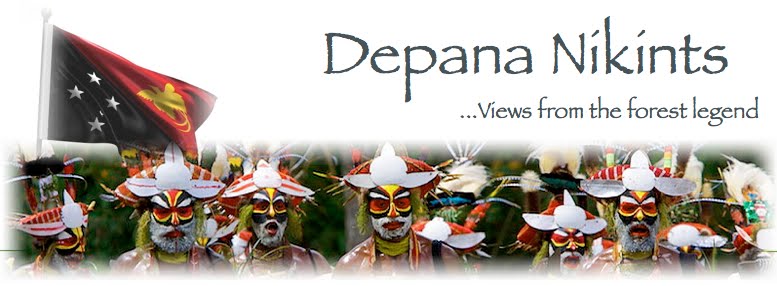
This blog is attributed to the forest legend of the Melpa speaking people of the Western Highlands Province of Papua New Guinea. Depana Nikints is committed to issues surrounding the environment (forests, seas, land etc)and pressing issues affecting indigenous people and communities in PNG, and Asia-Pacific region.